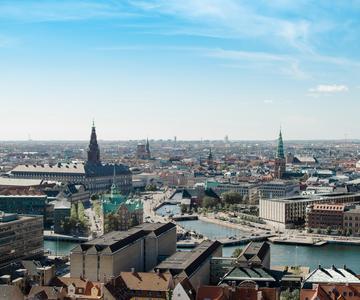
Circular Construction Hub Taking Shape in Greater Copenhagen
In late March 2026, we sat down with Anne Thorlak, Chief Consultant and Project Manager at Gate 21, the partner leading CirCoFin activities on the ground in showcase city, Greater Copenhagen. With the project now more than half-way through, we were curious to understand any progress, successes or set-backs that have taken place. Read our conversation with Anne below.
CirCoFin: More than a year has passed since the beginning of CirCoFin. Greater Copenhagen has been hard at work developing a Circular Construction Hub (CCH). How’s it going so far?
Anne: During this first year we’ve focused on building a strong foundation. We started by building a full overview of the stakeholder ecosystem. We did this through in-depth bilateral meetings with stakeholders across the entire value chain. We also saw the value of getting all these people in a room together, so we brought together more than 20 experts to form an expert panel that represents key parts of the industry. We held the kick-off meeting of this panel in March 2026.
Our pre-feasibility study has also been completed. This gives us a clear understanding of the main barriers and drivers of developing the CCH, as well as an overview of the legal framework it will operate within and governance options that will need to be considered.
All of this puts us in a good position as we move into the feasibility phase. Here, we’ll continue working along four tracks, focusing on digital solutions and exploring three distinct operating models (publicly owned, privately operated; contractor owned and operated; and builders’ merchant owned and operated). Each of the tracks will be brought to life through cases developed in collaboration with potential future owners of the CCH. We will follow these cases in parallel and assess which one has the strongest potential within our timeframe.
CirCoFin: You mentioned exploring three operating models. Selecting or developing the right one is of course crucial for long-term success. Have any of the options tested so far appear to be particularly promising?
Anne: What we’re seeing so far is that the most viable governance model in a Danish context is one in which the CCH is publicly owned but operated by a private actor. That conclusion is based on the dialogues we’ve had with a series of key actors, among them municipalities, the Capital Region of Denmark, waste utilities, the insurance industry, consultants and contractors.
At the same time, we’re not locking ourselves into just one path. We’re exploring case-specific tracks with ambitious private actors to understand whether a fully privately operated model could work under the right conditions. So, the governance work right now is very much about keeping several options open while building on what we know is feasible.
For the digital platform we’re currently looking into a joint venture between several value chain partners.
CirCoFin: In Greater Copenhagen you are busy combining both a physical hub - the CCH - and a Digital Material Bank and building materials registry. How far has the digital infrastructure progressed, and what key milestones have been reached?
Anne: On the digital side, we’ve made strong progress. Our project partner, Circue, has tested a digital market exchange pilot, built as an “exchange-on-top” model. This means it connects and integrates existing platforms rather than replacing them.
We have also held several alignment meetings with Concular and other digital stakeholders to address key issues such as data structures, cross-border compatibility, and how different business models can work together.
A core priority is to develop a solution that supports both the physical and digital ecosystem. In practice, this means creating a digital CCH that manages material data and material passports, enabling material assessment, brokerage, and early-stage matchmaking. At the same time, it connects with the physical CCH by supporting logistics, delivery, and tracking how materials are reused.
Overall, the groundwork for the digital infrastructure is now in place. The next step is to secure investments that align with the broader goals of CirCoFin.
CirCoFin: That sounds like promising progress! Ensuring interoperability with existing Danish platforms is, of course, a priority. What technical or organisational challenges have emerged in aligning these systems?
Anne: One of the main challenges is the fragmented digital landscape. Existing platforms use different data standards, require different types of documentation, and are at varying levels of maturity, which makes alignment complex.
There are also organisational constraints. Public actors, for example, face legal limits in operating commercial digital services, which can create barriers when trying to connect systems.
All of this highlights the need for a coordinated exchange layer, along with a clear division of roles going forward. At the same time, we are working towards a model with distributed ownership, where multiple stakeholders are not only users but also co-owners of the value chain.
CirCoFin: Are you already seeing early signals - in data, stakeholder behaviour, or market interest - that suggest growing confidence in material reuse?
Anne: Yes, we are already seeing encouraging signals. Digital actors like Circue are showing that it is possible to build infrastructure that enables earlier and more accurate matchmaking between supply and demand. The next step is securing the investments needed to scale these solutions.
At the same time, the Capital Region of Denmark is preparing a public tender focused on processing materials from publicly owned demolition sites, while also exploring future concepts, locations, digital platforms, and partnerships for circular construction hubs.
We are also seeing reuse requirements start to appear in tenders from building owners, which could translate into concrete solutions such as circular construction hubs developed by contractors.
In parallel, interest is growing among private actors exploring whether operating construction hubs could become part of their core business. Feedback from our expert panel supports this trend: both demolishers and contractors report strong demand for heavy materials like hollow core slabs, which are already being reused to some extent and could scale further under the right conditions.
CirCoFin: What about in the next couple of years? What specific developments would indicate that Greater Copenhagen’s model is ready to scale or be replicated elsewhere?
Anne: What we will hopefully be seeing within the next two years is that the key players have made the investments needed to get things moving.
We finally have the foundation for a fully functional digital exchange layer that can plug into the platforms already out there, and at the same time we’re seeing real, physical construction hubs starting to take shape. They’re showing that the whole concept is not just theoretical — it works in practice. They have political backing, they have local support, and they’re proving that the usual myths about price, quality, traceability and logistics simply don’t hold. These hubs demonstrate what material reuse looks like when it’s done at scale. And when you combine that with the digital layer, it creates exactly the momentum we need to accelerate, not only nationally, but internationally too.
CirCoFin: It sounds like things are advancing steadily in Greater Copenhagen. We look forward to seeing how things progress in the months ahead!
Publishing date: